As a #security professional, you frequently serve as the initial on-scene responder charged with securing the incident scene, conducting a rapid risk assessment, and instituting immediate, life‑preserving clinical interventions. Whether assigned to a corporate campus, health-care facility, educational institution, or retail complex, your responsibilities encompass public safety and the prehospital medical response. What clinical skills and procedural priorities should you be prepared to execute when an incident is medical rather than criminal?
Two ChildCareEd courses that translate directly to the on-duty skills security staff need are Adult First Aid & Adult CPR/AED (Blended) Buy Now $85.00$80.00 and Adult/Child CPR & AED with Adult First Aid (Blended) Buy Now $85.00, both designed to combine self-paced knowledge with in-person skills verification. Having either credential on your resume demonstrates readiness and competence to employers in regulated or high-liability settings.
Knowing #CPR and First Aid isn’t just a job requirement—it’s a professional edge and a personal responsibility. At AidCPR, we offer flexible, practical training designed specifically for professionals like you. Here’s why every security guard should be trained in Adult First Aid and CPR/AED, and how that training can be the difference between life and death.
What medical emergencies do security professionals actually encounter on the job?
Picture this: You’re patrolling your usual route in the late afternoon when a coworker radios you—someone’s collapsed near the building entrance. You rush over and find a middle-aged man unconscious on the ground. He’s not breathing, and there’s no pulse.
What do you do?
A CPR-certified responder implements a systematic, evidence-informed approach: rapid scene safety assessment, prompt activation of emergency medical services, provision of guideline-concordant high-quality chest compressions, and timely defibrillation with an AED when indicated. Security officers frequently represent the earliest professional presence at large venues and facilities; targeted training equips them to deliver temporizing interventions that maintain perfusion and mitigate secondary neurological injury until EMS assumes definitive care. Industry examples document that event staff and security are often first to a medical collapse and therefore benefit from formal CPR/First Aid training.
If you’re not trained? You’re left panicking, waiting helplessly while each second slips by—seconds that could mean the difference between life, death, or permanent brain damage.
Why is CPR and First Aid training critical for security professionals?
- You Are the First Responder
While security professionals aren’t officially classified as EMS, in many emergencies, you’re the first person on the scene. CPR and First Aid training bridges the gap between crisis and professional medical care, making you a vital first link in the chain of survival. - It's Often Required by Employers and State Regulations
Many companies and institutions require CPR/AED certification for security roles. But instead of viewing it as just a checkbox, think of it as a badge of readiness. AidCPR’s courses meet all OSHA and local compliance standards, so you're covered. - It Enhances Your Professional Value
A CPR-certified guard is more employable, more trusted, and more capable. Whether you're looking to advance in your current role or apply for a new one, having valid First Aid and CPR/AED certification on your resume shows you're serious about your responsibilities. - It Builds Confidence in Emergency Situations
Emergencies are chaotic. Without proper training, even the most composed individual can freeze. AidCPR’s blended and in-person courses are designed to make you feel confident, not confused. You’ll learn real-world skills through hands-on drills and scenarios, so when it’s go-time, you’ll act—not guess. - You Can Save a Life
This isn't hyperbole. CPR can double or triple a person’s chance of survival if administered quickly. And the AED? It’s often the only thing that can restart a heart in cardiac arrest. Being trained means you're never a bystander.
What other First Aid skills should security staff master besides CPR?
Medical emergencies go beyond cardiac arrest. As a security professional, you might deal with: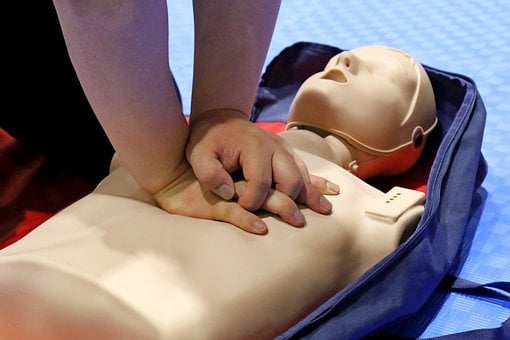
- Severe bleeding from accidents or altercations
- Burns from electrical or fire incidents
- Choking emergencies in public dining areas
- Seizures, allergic reactions, or diabetic emergencies
AidCPR’s training covers many common on-site medical events: hemorrhage control, burn first aid, choking relief, seizure recognition, allergic reactions, and diabetic emergencies. You will learn standardized assessment and stabilization steps designed for non-EMS responders.
Which ChildCareEd courses help security professionals prepare?
ChildCareEd offers multiple course formats that meet the practical needs of security teams. Relevant options include:
- Adult First Aid & Adult CPR/AED (Blended) Buy Now
$85.00$80.00 — blended knowledge plus in-person skills verification for adult-only response. - Adult/Child CPR & AED with Adult First Aid (Blended) Buy Now $85.00 — adds child CPR for mixed public settings.
- CPR & AED Adult only (In-person) Buy Now $70.00 — condensed hands-on certification suitable for shift-focused teams.
For implementation guidance and related training models, see ChildCareEd articles on the training process and remote skills options: AidCPRProcess, The Benefits of CPR Remote Skills Training, and practical community framing in First Aid and CPR: An Investment in Community Safety. These pieces explain blended delivery, skills verification, and employer-level planning that help security teams scale training efficiently.
A Hypothetical You Should Consider
You’re stationed at a shopping mall. A mother screams—her toddler is turning blue and can’t breathe. The food court goes silent. Dozens of people look around for someone—anyone—who knows what to do.
Do they see you stepping forward confidently, performing back blows and chest thrusts, then comforting the child and parent as color returns to the child’s face?
Or do they see you freeze, unsure how to help, hoping someone else does?
Training means you become the person others rely on in a crisis. At AidCPR, we make sure you’re ready for that moment.
Why Choose AidCPR?
- Blended and In-Person Options: Providers should offer self-paced didactic content plus in-person or remote skills verification so teams can demonstrate competence under observation.
- Scenario-Based Skills Practice: Realistic drills and scenario practice build competence and reduce cognitive overload during real events.
- Flexible Delivery: Evening, weekend, and on-site group training reduces operational disruption for 24/7 security shifts.
- Team/Group Pricing and Workforce Solutions: Employers should seek providers that support cohort scheduling, documentation, and team tracking.
Industry training programs often include these elements as standard. For example, security-industry academies list First Aid and AED/CPR as fundamental certifications for new officers; see an example academy overview here.
How should security professionals act now to be ready when seconds count?
Don’t wait for an incident to expose training gaps. If you are an individual operator, enroll in an accredited blended or in-person First Aid and CPR/AED course to ensure both knowledge and observed skills. If you supervise a team, schedule a cohort session with skills verification and maintain documented certification records.
ChildCareEd enrollment options (including blended Adult First Aid & CPR/AED) are available on the training page: Adult First Aid & Adult CPR/AED (Blended) Buy Now $85.00$80.00. For team-oriented delivery, consider on-site skills verifications or group bookings described in our process article AidCPRProcess and the practical considerations in Got CPR and A Well-Stocked First Aid Kit?.
Sign-up resources: Enroll at the ChildCareEd training pages above or consult your employer about group scheduling. For additional reading on implementation and pediatric considerations, see Pediatric First Aid and CPR Training and Getting Ready for the New School Year.
Sign up today and be ready when seconds count.
For enrollment, visit the ChildCareEd course pages linked above or contact your preferred provider about group delivery. Security supervisors should document certifications in personnel files and plan recurring refreshers every 1–2 years, depending on employer policy and local regulations.
How can security teams sustain readiness and document competence over time?
To sustain operational readiness, integrate documented training, scheduled skills verification, and routine team practice into workforce processes. Individual practitioners should enroll in accredited blended or in-person First Aid and CPR/AED courses that include skills verification and retain evidence of competence. Supervisors should maintain centralized training records, organize cohort verifications, and incorporate scenario-based drills (tabletop and live) to preserve decision-making skills and reduce response latency. Prioritize ongoing occupational documentation and plan refreshers on a cadence appropriate to your agency and local regulations; doing so embeds these competencies into routine workforce management. Maintain core competencies for the workforce—think #FirstAid, #AED, and #Emergency preparedness alongside #CPR and #security.
Remember: Security professionals are trained to respond to risk — adding validated First Aid and CPR/AED certification completes the capability to preserve life during intervals before EMS arrival.
Related ChildCareEd articles: Don't Let Emergencies Make You Scream!!, Celebrate Heart Month: Learn CPR & First Aid, and Give the Gift of Life This Holiday.
- AidCPRProcess
- CPR Training: Because Glue Sticks Can’t Fix Everything!
- Be the Hero Before Backup Arrives: First Aid & CPR Training for Security Pros
- ❤️Goldfish, Glue Sticks & 911: Why CPR & First Aid Is Non-Negotiable for Childcare Providers
- 🚨Be the Difference: Why First Aid & CPR Training Should Be Mandatory in Every School💓🎓
