What counts as “infant CPR,” and when do you use it?
Infant CPR is for babies under 1 year old. You use it when a baby is unresponsive (does not wake up) and is not breathing normally (not breathing or only gasping).
What should you do first in a child care setting?
Before you start CPR, do these quick #safety steps:
- Make sure the area is safe for you and the baby.
- Shout for help so another #staff member can jump in right away.
- Call 9-1-1 (or have someone else call) and send someone to get the AED if you have one.
- Use PPE if you can (like gloves) and use a CPR mask if available.
If you are alone and you have a phone, call 9-1-1 and start CPR. If you must step away to call, give about 2 minutes (5 cycles) of CPR first, then call and return quickly.
How do you check an infant fast (without wasting time)?
Use a quick check:
- Tap the bottom of the baby’s foot and speak loudly (like, “Baby, are you okay?”).
- Look for normal breathing (chest rising).
- Take no more than 10 seconds to check.
If the baby is not responding and not breathing normally, start CPR.
Where do you place your fingers (or thumbs) for infant chest compressions?
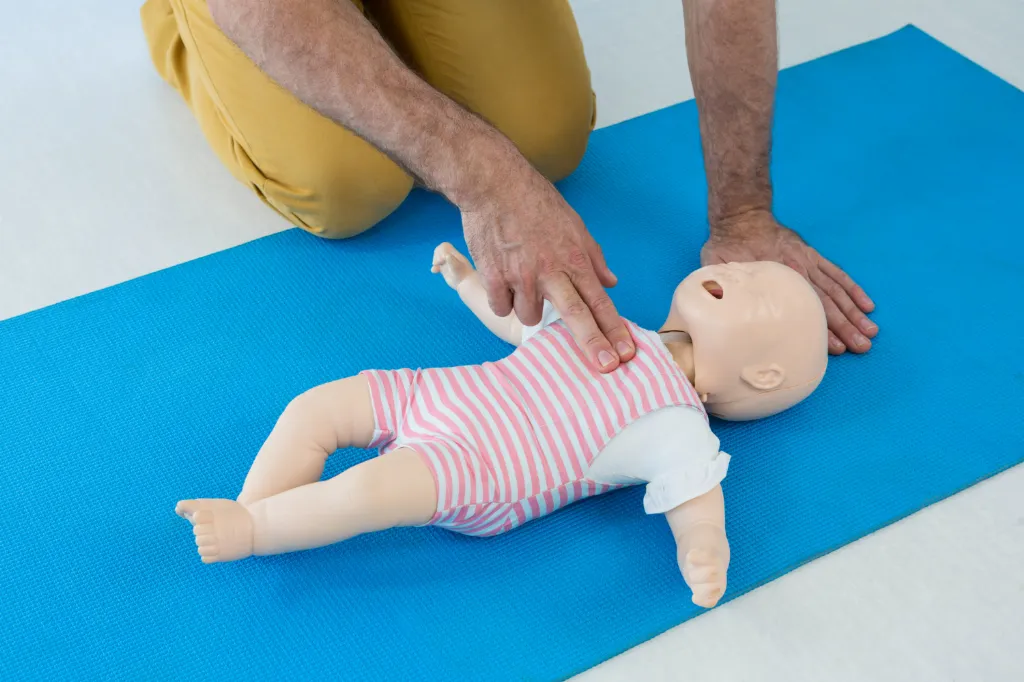
Place pressure on the center of the chest, just below the nipple line.
You may #learn more than one safe method in training:
- Two-finger method: 2 fingers in the #center of the chest (often used when you are alone).
- Two-thumb method: thumbs on the chest while your fingers wrap around the baby’s back (often used with teams, and can help you press evenly).
Use the method your training program teaches, and focus on good depth and steady rhythm.
How fast and how deep should infant compressions be?
Good compressions are the heart of CPR.
- Depth: about 1½ inches (about one-third of the chest depth).
- Rate: 100 to 120 compressions per minute (a fast, steady beat).
- Let the chest come back up after each push (full recoil).
Tip: Counting out loud helps you stay on track and helps others join in smoothly.
How do you give rescue breaths #safely to an infant?
After compressions, you give breaths (unless your program has a “hands-only” rule for certain situations—follow your training and local policy).
Here’s the basic idea:
- Keep the baby on a firm, flat surface.
- Hold the head in a neutral position (not pushed back too far).
- Seal your mouth over the baby’s mouth and nose (or use a mask).
- Give gentle breaths—only enough to see the chest rise.
If the chest does not rise, re-position the head and try again. Do not blow hard.
What is the simple infant CPR pattern (and how does it change with two rescuers)?
Most child care providers learn this pattern:
If you are alone (single rescuer):
- 30 compressions
- 2 breaths
- Repeat cycles
If you have a trained team (two or more rescuers):
- You may use 15 compressions before breaths (team pattern).
- Switch who does compressions about every 2 minutes so compressions stay strong.
When should you use an AED on an infant?
Use the AED as soon as it arrives.
Quick AED tips:
- Use pediatric pads if you have them (follow the AED instructions).
- Keep doing CPR while someone else turns the AED on and places pads.
- Follow the AED voice prompts and pause only when it tells you to.
What should you do until EMS arrives?
Keep going until #emergency help takes over or the infant clearly recovers.
While you continue CPR:
- Keep the baby warm (a small blanket can help).
- Watch for any signs of recovery (breathing, movement).
- If the baby starts breathing normally, keep close watch and be ready to start CPR again if breathing stops.
- After the emergency, document what happened (time CPR started, who called 9-1-1, when AED arrived, etc.).
For a helpful refresher on infant vs. child CPR details, read: CPR for Infants and Children: Special Considerations and Techniques
How can you get ready before an emergency happens? 
Preparation lowers panic. Try these simple habits:
- Do a quick monthly check of emergency supplies (gloves, CPR mask, updated contact list, etc.). An emergency checklist can help: Emergency Supply List Buy Now $0.00
- Practice roles with your team:
- Person 1: CPR
- Person 2: Calls 9-1-1
- Person 3: Gets AED and emergency bag
- Keep your CPR skills current with training and hands-on practice.
If you or your staff need training options, these AidCPR courses include infant CPR skills:
- CPR & AED Adult, Child, Infant - Blended Buy Now $85.00
- Pediatric Blended First Aid & CPR/AED Adult, Child, Infant Buy Now
$85.00$80.00 - Pediatric RSV First Aid & CPR/AED Buy Now
$115.00$95.00
And for ongoing tips and reminders, follow ChildCareEd on Pinterest (great for quick visuals and staff-room ideas)
- Adult Only CPR AED and Adult First Aid Blended
- Basic Life Support (BLS) Blended Healthcare Providers
- CPR & AED Adult, Child, Infant - Blended
- Pediatric Blended First Aid & CPR/AED Adult, Child, Infant
- Pediatric RSV First Aid & CPR/AED
- Pediatric In-Person First Aid & CPR/AED Adult, Child, Infant
- CPR & AED Adult, Child, Infant - In Person
