Introduction
This article helps child care providers and directors know when to give #CPR, when to give #breaths, and when to focus on #compressions. It is written in simple steps you can use during an emerg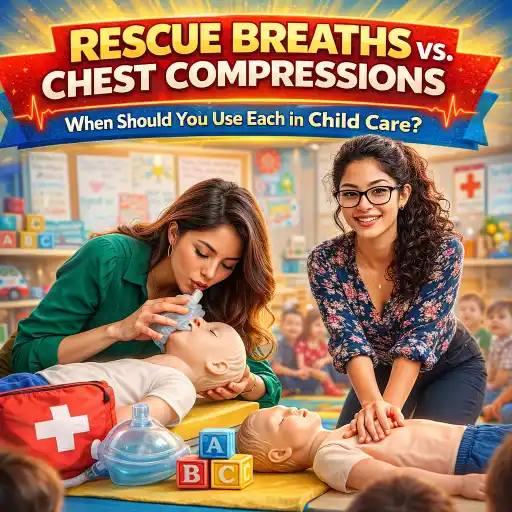 ency. We use clear rules from recent guidelines and trusted child care resources so you can act fast and feel confident. For training and center-focused help, see CPR for Infants and Children: Special Considerations and Techniques and Infant CPR Steps.
Quick note: state requirements vary - check your state licensing agency.
What are rescue breaths and chest compressions, and why do they matter?
Rescue breaths are breaths you give to a child who is not breathing. Chest compressions are pushes on the chest to keep blood moving when the heart is not pumping well. Both help deliver oxygen to the brain and heart. In children, breathing problems often start the emergency, so both parts can be important.
Simple definitions:
- 🟢 Rescue breaths: give gentle puffs of air into the mouth (and nose for infants) so the chest rises. See step details in Infant CPR Steps.
- 🔵 Chest compressions: press the center of the chest at the right depth and speed to move blood. AHA guidance recommends good depth and a rate of about 100–120 compressions per minute; for children the depth is smaller than adults (pediatric resuscitation basics).
Why it matters: 1) Children often have low oxygen first, so breathing helps. 2) High-quality compressions keep blood flowing. New guidelines emphasize combining both for babies and children when the rescuer is able (2025 AHA guidelines summary).
In short: breaths fix oxygen problems; compressions keep blood moving. Use the part that fits the cause of the emergency. Learn both—your #rescue actions can save a life.
When should I use rescue breaths versus chest compressions for infants and children?
Follow simple rules based on what caused the problem. Use this short list to decide fast. Key idea: if the problem began with breathing (drowning, choking, severe illness), breaths are critical. If the heart stopped suddenly for other reasons, compressions are vital.
- 🔹 Emergency from breathing trouble (most pediatric cases):
- Examples: drowning, choking that led to not breathing, severe asthma, overdose. In these cases, include rescue breaths with compressions. Research shows bystander CPR with ventilations helps children more than compressions alone (German registry study).
- 🔸 Sudden collapse in an adult-like cardiac arrest (rare in kids):
- If the child suddenly collapses and you suspect a primary heart problem, start compressions immediately and get the AED. For older children with sudden cardiac events, defibrillation and compressions are priorities (AHA 2025 guidance).
- ⚠️ Drowning or near-drowning:
- Give rescue breaths as soon as you can. Drowning causes low oxygen first, so breaths plus compressions are more effective than compressions alone (drowning review and news on drowning guidance).
Note from studies: when rescue breaths were used less during the COVID era, pediatric survival dropped. That shows how important breaths are for many children (study on rescue breathing decline).
How do I perform rescue breaths and chest compressions safely in a childcare setting?
Keep steps short and practice them often. Below are simple, safe steps you can follow. For details and hands-on practice, use training resources like ChildCareEd CPR for Infants and Children and local AHA or Red Cross classes.
- Check and act quickly (10 seconds max):
- 1) Ensure scene is safe. 2) Tap and shout. 3) Call for help and send someone to call 911 and get the AED. (state requirements vary - check your state licensing agency.)
- If unresponsive and not breathing normally:
- Infant (
- • 30 compressions with two fingers or two-thumb encircling method if two rescuers; depth ~1.5 in (about one-third chest). See Infant CPR Steps.
- • Give 2 gentle breaths covering mouth and nose. Repeat cycles.
- Child (1 year to puberty):
- • 30 compressions (single rescuer) or 15 compressions (two rescuers) at about 2 inches depth for most children. Then 2 breaths; repeat. Use AED when available and follow voice prompts (pediatric resuscitation).
- Practical safety tips:
- 🔻 Use a barrier mask or pocket mask for breaths when available.
- 🔻 Wear gloves and follow infection-control policy.
- 🔻 Switch compressors every 2 minutes to avoid fatigue.
For choking that becomes unresponsive, start CPR and check the mouth for objects before breaths. For step-by-step choking care in toddlers and preschoolers, see ChildCareEd choking guidance.
How can my program prepare, avoid mistakes, and support staff after an event?
Preparation, practice, and clear roles make real emergencies easier. Use short drills, refresh skills monthly, and keep equipment ready. ChildCareEd suggests monthly practice plans and quick drills to keep skills fresh (monthly practice tips).
- Training and practice:
- 1) ✅ Schedule regular staff training with hands-on practice. See quality course ideas on Help-A-Heart CPR and ChildCareEd resources. For programs wanting scheduled instructor-led sessions and pediatric-focused modules this winter, consider AidCPR's February training offerings to make heart health a center priority: AidCPR February CPR training and heart-health sessions.
- 2) 👥 Run 10–15 minute monthly drills: first minute steps, compressions practice, choking drills, AED location checks.
- Common mistakes and how to avoid them:
- ❌ Mistake: skipping rescue breaths for children who need them. Fix: teach when breaths are needed (drowning, choking, slow breathing).
- ❌ Mistake: poor compression depth or rate. Fix: practice with feedback devices and swap compressors often.
- ❌ Mistake: blind finger sweeps of the mouth. Fix: only remove visible objects by sight.
- Program readiness checklist:
- 1) AED location and working pads; 2) stocked first-aid kit and barrier masks; 3) posted emergency numbers and chain of command; 4) updated staff certifications.
- After an event: support staff and document:
- 1) Provide debrief and emotional support for staff and families. 2) Document times (when CPR started, when 911 was called, and AED use). 3) Review the event and update practice plans.
When you explain how CPR changes for infants and children (and why child emergencies often start with breathing), link Pediatric Blended First Aid & CPR/AED Adult, Child, Infant right in that section: https://www.aidcpr.com/courses-first-aid-cpr-blended.html Buy Now $85.00$80.00. (aidcpr.com Buy Now $85.00$80.00)
And when you describe the core “what to do first” sequence—calling for help, starting compressions, adding rescue breaths when needed, and using an AED—link CPR & AED Adult, Child, Infant – Blended right in your step-by-step part: https://www.aidcpr.com/courses-cpr-aed-adult-child-infant-blended-3989.html Buy Now $85.00. (aidcpr.com Buy Now $85.00)
FAQ (quick):
- Q: If I am afraid to give breaths, should I still do something? A: Yes — do hands-only compressions until help arrives, but try to get someone trained to give breaths for children (research shows breaths matter).
- Q: When do I use the AED? A: Turn it on as soon as it’s available; continue CPR while it charges and follow prompts.
- Q: Should we run drills? A: Yes — short monthly drills keep skills ready (monthly practice).
- Q: Where can staff get training? A: Local AHA, Red Cross, or ChildCareEd courses are good options with pediatric focus.
Conclusion
In child care, most emergencies start with breathing problems. That means rescue breaths plus compressions are often the best choice for infants and children. Learn both skills, run short monthly drills, and keep your AED and supplies ready. Use trusted resources like ChildCareEd and the latest AHA guidance (2025 update). Your calm, practiced #rescue can save a child. Remember: state requirements vary - check your state licensing agency.
