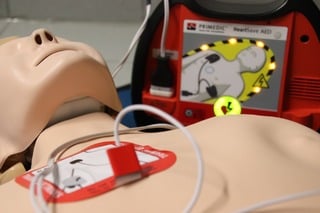
 Imagine you’re on the #playground with your #students, or in your #daycare #classroom, and a sudden medical #emergency occurs. Someone collapses, and you realize they’re unresponsive. Panic sets in, but then you remember: you’ve been trained to respond. You know how to perform CPR and, more importantly, you know how to use an Automated External Defibrillator (AED). This tool can mean the difference between life and death, and having the confidence to use it is a skill every #teacher, #daycare-provider, and parent should have. If you need practical training aligned to childcare requirements, consider ChildCareEd's Pediatric In-Person First Aid & CPR Buy Now $95.00 or the CPR & AED (Adult, Child, Infant) – In Person Buy Now $90.00 course to get hands-on experience and certification.
What is an AED and how does it work?
An automated external defibrillator (AED) is a small, portable device that analyzes cardiac rhythm and, when appropriate, delivers an electrical shock to terminate life-threatening arrhythmias associated with sudden cardiac arrest (SCA). AEDs empower lay responders by providing voice and visual prompts and by automatically assessing whether a shock is needed; their design minimizes user error and allows immediate action at the scene (WVM Health Services – AED).
Why should teachers, daycare providers, and parents learn AED and CPR skills?
Rapid defibrillation combined with high-quality CPR are the primary determinants of survival after out-of-hospital cardiac arrest. Each minute without defibrillation reduces the chance of survival by roughly 7–10%; early AED application as part of a comprehensive public access defibrillation (PAD) program substantially increases survival and favorable neurological outcomes (CDC PAD fact sheet).
In early childhood settings, preparedness shortens the interval to treatment, clarifies staff roles during an emergency, and improves coordination with emergency medical services. Practical readiness is covered in several of our related articles: Pediatric First Aid and CPR Training, Why Child Care Providers Should Get CPR & First Aid, and Why Pediatric First Aid Is Crucial.
Which ChildCareEd course formats work best for childcare professionals?
Choose the format your licensing or program requires. Blended courses combine online knowledge modules with a concise in-person skills check and are efficient for experienced staff; fully in-person courses provide extended hands-on practice and scenario-based drills. ChildCareEd options that match common childcare needs include Pediatric Blended First Aid & CPR/AED Buy Now $85.00$80.00, Pediatric In-Person First Aid & CPR Buy Now $95.00, and CPR & AED (Adult, Child, Infant) – In Person. Verify acceptance of blended formats with your licensing agency before relying on a specific course for compliance.
How can you integrate AED readiness into your program?
Operationalize readiness with a short, repeatable plan: 1) map AED placement and ensure clear access; 2) identify and train at least two staff who will respond; 3) practice a scripted drill that includes 911 activation, scene safety, CPR, and AED use; 4) record training and device maintenance; and 5) coordinate with local EMS for post-event debrief and quality improvement. See additional practical guidance in our implementation pieces: Getting Ready for the New School Year, The Benefits of CPR Remote Skills Training, and The Importance of Pediatric First Aid for Teachers.
How should early childhood programs design AED placement, maintenance, and training?
Designing a reliable AED program in early childhood settings requires alignment of placement strategy, staff competency development, and documented maintenance so that response is rapid and sustainable. Targeted placement should ensure AEDs are sited where cardiac arrest is most likely to occur and where access is unobstructed; the CDC notes that site selection and EMS linkage are central attributes of effective public access defibrillation (PAD) programs (CDC PAD fact sheet). Consider a site survey that evaluates: foot traffic patterns, travel time to the device from typical activity areas, visibility and signage, and barriers to access during arrival and departure times.
Training and role assignment are equally important. Identify at least two anticipated responders on each shift and incorporate short, frequent skill refreshers into routine staff meetings. Structured practice should include scripted drills that simulate discovery, 911 activation, scene safety assessment, simultaneous initiation of high-quality CPR, and prompt AED application. Integrate AED drills with local EMS so dispatch and post-event handoff are practiced; the CDC recommends EMS coordination and continuous quality improvement as part of a PAD program (CDC PAD fact sheet).
Device maintenance and documentation create reliability. AEDs are designed for lay responders and have built-in readiness indicators, but programs must assign someone to check battery and pad expiration, test readiness indicators per manufacturer guidance, and log routine inspections. WVM Health Services summarizes that AEDs are portable and intended for lay use, and that prompt CPR plus AED use substantially increases survival probability (WVM Health Services – AED).
Operational checklist (adaptable for most child care programs):
- Conduct an AED site survey and publish a simple floor plan showing AED locations and travel times to high-use areas.
- Assign anticipated responders by shift and document primary/backup responders in your emergency plan.
- Schedule brief quarterly drills that include 911 activation, CPR, AED application, and EMS handoff; debrief after drills to identify bottlenecks.
- Maintain an AED log (inspections, battery/pad expiration, software updates, and post-event reports).
- Coordinate with local EMS for registration of AED locations and a post-event quality-improvement review.
Implementing these elements embeds AED readiness into everyday practice and clarifies responsibilities across staff and leadership. Emphasize that AEDs are adjuncts to high-quality CPR: immediate chest compressions and rapid defibrillation together maximize the chance of survival for out-of-hospital cardiac arrest, which is why facility planning, routine practice, and device maintenance are non-negotiable components of program safety (CDC PAD fact sheet; WVM Health Services – AED).
What Will You Learn in Our Upcoming In-Person Class?
At our upcoming class, you’ll:
-
Learn how to perform high-quality #CPR for adults, children, and infants.
-
Understand how and when to use an AED.
-
Practice choking relief techniques.
-
Gain insight into how to stay calm and coordinate with emergency responders.
Why Wait? Join an Upcoming Class Buy Now $95.00
Emergencies don’t wait, and neither should you. Sign up for an upcoming in-person CPR and AED training near you and consider current special offers from our training partners. Whether you’re a teacher, daycare provider, or parent, these classes are designed for hands-on skill mastery. Prefer a blended option? You can complete part of the training online and attend a supervised skills session to meet hands-on requirements.
Don’t miss this opportunity to become a lifesaver. Register today and take the first step toward being someone’s hero. Your students, children, and community are counting on you!
Summary: What should you do next?
Actionable next steps: 1) Enroll in a course that matches your role—consider ChildCareEd's Pediatric In-Person First Aid & CPR Buy Now $95.00 or the Pediatric Blended First Aid & CPR/AED Buy Now $85.00$80.00 for flexible learning; 2) Practice AED use and high-quality CPR at least twice a year with colleagues; 3) Work with your program director to place AEDs in accessible locations, document maintenance, and run an annual drill; 4) Confirm your course format is accepted by your licensing agency before relying on it for regulatory compliance. For evidence-based program design and placement guidance, consult the CDC PAD overview (CDC PAD fact sheet) and operational AED basics (WVM Health Services – AED).
- Give the Gift of Life This Holiday: Take CPR Training with AidCPR
- First Aid and CPR: An Investment in Community Safety
- Got CPR and A Well-Stocked First Aid Kit?
- Save Lives with Ease: Take Your BLS Training with AidCPR this Heart Month!
- Boost Your Life-Saving Skills with BLS Training at AidCPR!
- CPR Training: Because Glue Sticks Can’t Fix Everything!
- 🚨 Emergencies Don’t Make Appointments!
- Flex Your Safety Muscles: Why Every Fitness Pro Needs First Aid & CPR Training
- 🌞 Don't Let Summer Fun Turn Scary — Be CPR Ready with AidCPR!
- 💓Be a Lifesaver, Not a Bystander: Why Getting First Aid & CPR Certified Matters More Than Ever
- The Life-Saving Power of Knowing CPR: Why It Matters More Than You Think
